Wednesday, 18 March 2015
Air Intake Screens: The problem with free cooling
Air Intake Screens: The problem with free cooling: Is that it relies upon an efficient transmission of air through the fin coils to allow the fans to work at maximum efficiency with the lowes...

Friday, 6 March 2015
Small investments, huge savings
The Health Estate Journal recently ran an article under the heading "Small investments, huge savings".
It states that one of the key conclusions from the IHEEM Healthcare Estates 2014 conference was that basic energy efficiency measures could "shave millions of pounds from NHS estates' running costs", and that hospitals and other healthcare buildings face both "an air conditioning legal crisis", and a growing threat from outdoor air pollution.
The whole article is very much worth a read, but one of the key statements is that there is plenty of "low hanging fruit" that any hospital can use to quickly, and cheaply improve energy efficiency.
This last statement is so very true.
Hospitals are a 24/7 operation and have a significant need for cooling which can be found at the heart of most HVAC systems.
In a recent example we surveyed two separate cooling systems at the same facility comprising 1 x Alfa Laval Fin coil unit SCAG-8-5 and 4 x Carrier 09GHCA-178.
The annual energy consumption for these cooling systems totalled 1,618,000 kWh which costs the trust just over £194K per annum to run.
As you can
see from the images below the horizontal coil faces were dirty with compacted
dust, seed, pollen and other debris drawn into the fins.

In a USA
study by Pacific Gas and Electric they identified that 1mm of debris on a coil
fin would cause a 21% drop in efficiency and increase energy consumption by as
much as 30%.
“When a
condenser is dirty or unable to reject heat or energy, heat increases both the
temperature and pressure of the refrigerant liquid line. The higher total
energy, increases the flash gas that decreases system efficiency and capacity” http://www.refrigtech.com/Knowledge_Center/Knowledge_Characteristics_Evaporators.pdf
By installing an air intake filter screen to protect the coil faces, contamination will be significantly reduced as the cooling season progresses.
The air intake screen is manufactured using a polyester core and polypropylene overlay which, during air movement, creates a static charge. This electrostatic charge easily captures the airborne particulate to PreVent® it getting through to the fins.
No airflow, no electrostatic charge and this enables maintenance personnel to easily clean the air intake screens using a vacuum cleaner, hose or brush.
By comparing with similar sites we would expect to see a minimum 10% reduction in running cost as the condenser is kept clean and efficiently rejects heat.
The air intake filter screens were secured to the coil support steelwork using marine grade, nylon drop tab fastenings. In the event that access to the fins is required the screens can be easily removed and replaced.
With an air resistance of only 17 pascals at 3.05m3/s this highly effective external filter will continue to protect the coils for at least 10 years and produce an ROI of less than 12 months.
That leaves the trust with savings of at least £175K over the next 9 years and why we are proud to be saving money for the NHS.
Richard Betts
Managing Director – RAB Specialist Engineers Limited
01635 248633
Monday, 16 February 2015
Experts. Are we just experienced or are we experts?
Experts. Are we just experienced or are we experts?
I saw this recent comment from a multi-trade specialist who are able to offer a range of services to the building services market.
Their comment says
"Contact our team of experts today and book your free"..............
I am always concerned when someone offers a free
anything because invariably this WILL end up costing money because someone always ends
up paying for it.
If you are offering to survey a project that requires the installation of anything to anything then how can you realistically cost the job without seeing it? Unless of course you are working to detailed drawings.
One of my ex-employees (Technical
Director) once saw two water tanks. Unfortunately he only
charged the customer for one, so even that doesn't always work.
Anyway let's get back to experts.
The word “expert” is formed from the conjunction of two roots which, phonetically, can be represented as “x” and “spurt”. Everyone knows that “X” is an unknown quantity, and that a “spurt” is what one gets from squeezing a drop of water. Therefore, an expert is an unknown drip under pressure.
Definition: Expert from an article by Jerry
Cates , first published on 24 August 2011
As Jerry says the above definition although amusing is not entirely correct.
Another definition from Brainy Quote suggests
Taught by use, practice, or experience, experienced; having facility of operation or performance from practice; knowing and ready from much practice; clever; skilful; as, an expert surgeon; expert in chess or archery.
However if you look at Wikipedia then:
"In line with the socially constructed view of expertise, expertise can also be understood as a form of power; that is, experts have the ability to influence others as a result of their defined social status. By a similar token, a fear of experts can arise from fear of an intellectual elite's power".
We all seek advice all of the time because let’s face it that is the only way to learn.
If you are selling a safety product then it is easy to influence others based upon
your level of experience.
By carefully wording the proposal you can generate a
fear factor.
Is that being an expert or commercial bullying?

At RAB we offer advice based upon our own
experience and have even stated:
"Technical expertise - the best people for the best service and the best finish"
But, are we truly experts or just very experienced at what we do?
That choice is one that we have to leave to our clients.
Take a look at www.rabse.com
and www.airintakescreen.co.uk
and make your own decision once you have spoken to one of our very experienced
people.
And finally "An expert is a man who has made all the mistakes which can be made, in a narrow field".
Friday, 6 February 2015
Thursday, 5 February 2015
Another way to use an air intake filter screen
In the world of air intake screens there always seems to be another
application you have never thought of before.
Many companies already recognise the benefit of fitting an external filter to any piece of air movement equipment was it
provides an additional protection layer for valuable plant.
That is why we have installed to dry air coolers, vertical
and horizontal chillers, air compressors, refrigeration display cabinets,
cooling towers, building main intake louvres and AHU air intakes as well as a
host of other cooling and air movement
machinery.
In a recent survey of a paper factory we were expecting to find paper fines and
the normal dust, seed and other airborne pollutants causing problems.

However, the writer was asked to survey the inside of this paper
processing plant and found that they had a big problem caused by the shreds generated on the production line.
Like most modern and highly automated factories this site
had miles of conveyor systems all controlled by sophisticated electrical
equipment mounted inside mild steel cabinets.
The control boards, switches and plc’s all generate heat and
to maximise the space each cabinet was also fitted with its own air conditioner.
These integral AC units (see http://seifertsystems.com/us/engineering/
for an example) draw ambient air into the enclosure which is then cooled,
circulated and discharged back into the factory.
This fan driven air supply also draws in the paper fines,
which are then deposited inside the enclosure and clog up the evaporator coil.
Obviously clogged fins are something that we have discussed
regularly (see http://www.airintakescreen.co.uk/cooling-coil-filters1
) but paper dust and fines laying on electrical components is another
risk we had never considered before. Maintenance requires regular shut
down and cleaning in order to minimise the risk of
fire.
That is why the electrical engineer was so excited when he
saw the patented Permatron R1 Magnetic Filter which could be placed on the intake
without drilling the cabinet.

Acting as an external filter the BHC Honeycomb Media attracts
the dust and paper fines and will keep the enclosure clean avoiding both
evaporator failure and minimising the
risk of fire.
During a recent failure the replacement cost was over £2,000.00 and also shut down the production line.
Yet
it could have been avoided with a simple
£65.00 high flow, low resistance filter which can be removed and cleaned
before refitting.It may not be superhero stuff but we were pleased that
another problem has been solved by an air intake filter screen from RAB
Specialist Engineers.
Tuesday, 16 December 2014
Air Intake Screens: Sampling the benefit
Air Intake Screens: Sampling the benefit: The problem with a relatively new product, even one that has been in the market for more than two years, is that most people do not tr...
Monday, 15 December 2014
It's a rat trap
There are not too many contracts where you have to consider
rats as a potential hazard.
In this particular barn the water pipe feeding the cows and
pigs ran through galvanised steel caps fitted tightly to the pen walls. When I
say tightly, that was the assumption which was so badly wrong.
The water pipe was 25mm Blue MDPE which was layered with
frost protection trace heating cable and mineral fibre insulation sections.
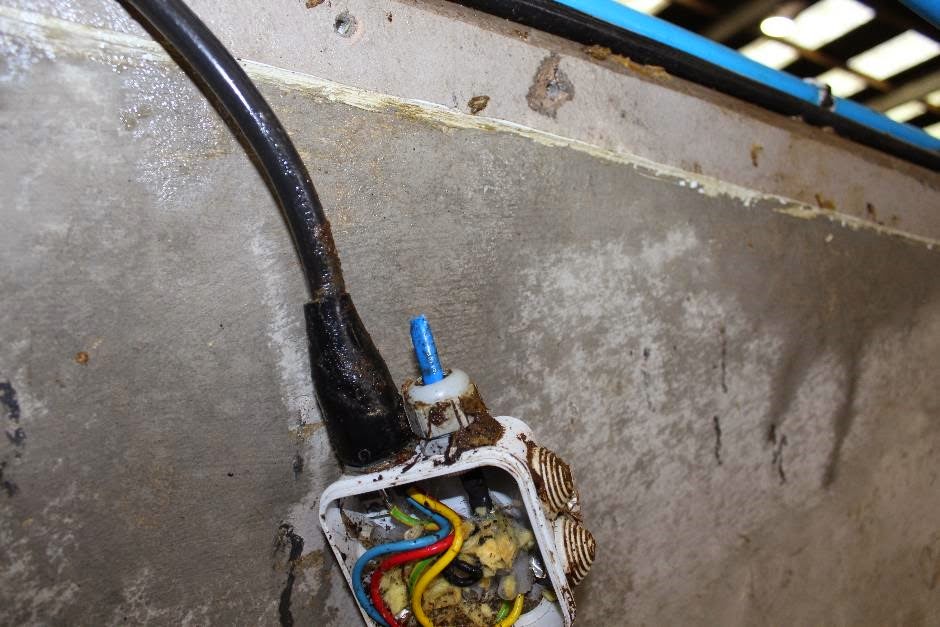
Regrettably the sealed metallic capping had been modified to allow cables and
outlets to be fitted and this allowed the rats to enter this dark and warm
place next to a ready supply of food and water.

This capping ran in multiple lines over an 80m length and
the Barn Town Rats thrived in the Rat Run.
These rodents need plenty of water and must also keep
gnawing to wear down their teeth. What better place than a dark duct with
mineral fibre for nesting, trace heating cable at low amps for chewing and of
course water pipe for gnawing. And if it gets too wet, then move further up the
duct and chew, gnaw, nest some more.

So back to the job.
Repair / replace missing insulation from exposed pipework,
disconnect redundant pipes where dead legs were in place and carry out minor
repairs to trace heating cable. The exposed areas were simple enough and there
was only minor damage to the cabling. There was some evidence of long deserted
nests and so we were armed with the appropriate PPE - coveralls, splash goggles
and chemically resistant gloves – which, with a fetching pair of white
wellingtons, made a significant fashion statement.
However, to remove the dead legs we needed to also remove
the steel caps. That is when we disturbed the rats and found that the visible nests
were just the tip of the iceberg.
The morning after the steam cleaning machine had broken as
the rats had made a new nest and gnawed the power cable. This was not a job for
RAB and so a local contractor called Extreme Environmental were called in to
assist. They stripped off the metalwork, cleared out the nests and cleaned the
pipework and walls with a disinfectant and biocide.
They looked like people from an Ebola outbreak station with
their facemasks, full body coveralls, boots, safety goggles and gloves but, as
rat mess contains particularly harmful diseases, it was the only way to tackle
the problem. Whilst they were cleaning
and making safe they also discovered further damage to the electrical cabling,
trace heating cable and junction boxes. More leaks appeared as we stripped the
steel ducting away from the walls and the job started to grow substantially.
No longer was it a minor repair as we needed to make safe
the cabling, remove rat damaged and wet insulation and repair a lot of pipework
leaks. And, as any pipefitter will tell
you, as you repair one weak point and refill the system the next weak point
fails leading to more repairs.

Oh yes and what of Big Bertha. She was the only rat who did
not run away when we disturbed her nesting point. Instead, she just stared
straight at me and did not move a muscle. And yes she was alive and no I was
not braver than she was.

That is why the farmer was called to do what farmers do best
and us lightweight engineering types did a swift exit from the building.
Subscribe to:
Posts (Atom)